
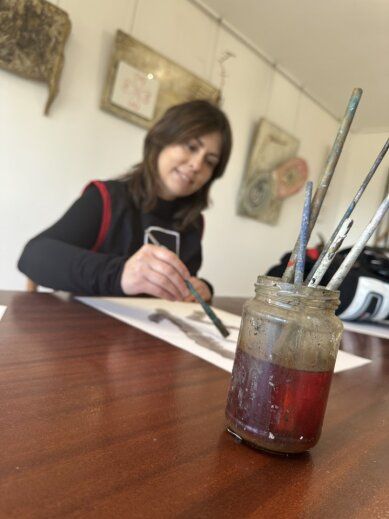
Art therapy offers unique tools to unlock your potential and heal your environment, including transforming exhaustion into calm through resilient art.
We invite you to read this post to learn how to integrate new thoughts and live a life in movement integrating art therapy as a resource in your favor and focused on daily well-being.
How art therapy dissolves stress and restores your center
In the fast pace of modern life, stress becomes white noise that disconnects us from our essence. However, there is a bridge to calm that does not require words, but colors and shapes: art therapy.
The discipline does not seek to create masterpieces for museums, but rather to use the creative process as a vehicle to transform anguish into serenity and strengthen our mental health. Next you will learn different 4 favorable and essential aspects of art therapy:
1. The canvas as a refuge of calm
When faced with a blank slate, we allow the right hemisphere of the brain to take control. When painting or molding, cortisol decreases, giving way to a state of flow where time stops.
This exercise is essential to recover daily well-being, as it offers a safe space where accumulated tensions find a physical and visual outlet.
2. Symbolic expression for balance
Burnout often comes from what we don’t know how to express. Art therapy allows you to project complex emotions through abstract strokes. By seeing our worries captured outside of ourselves, we gain perspective.
This act of externalization is the key to regaining emotional balance, allowing us to observe our challenges from a position of control and resilience.
3. Conscious connection and presence
Integrating creativity into our routine is not a luxury, it is a necessity to maintain health focused on calming and feeling full of well-being. By focusing on the texture of the paint or the mixture of hues, we practice a type of active meditation.
This conscious approach helps transform the perception of the environment, replacing stress reactivity with a slow and focused response.
4. Daily wellness routines
You don’t need to be an artist to benefit from these tools. The ultimate goal is for the balance you find in the studio or gallery to transfer to your personal life.
By dedicating moments to creation, you build a solid pillar for your daily well-being, ensuring that your center remains intact regardless of external pressures.
Practical art therapy exercises for sustainable well-being
Staying calm in a crowded environment requires tools that go beyond theory. Art therapy is presented as a dynamic resource to transform mental noise into creative silence.
By integrating small artistic practices into your routine, you not only manage momentary stress, but you build the foundations for resilient mental health and daily well-being that lasts over time. These are some practical recommendations to put into practice during your daily life:
1. Drawing rhythmic breathing
To regain balance immediately, take a marker at the rhythm of your inhalation and exhalation, draw continuous lines on the paper. Don’t look for a geometric figure; let the movement of your hand be a mirror of your lungs.
This art therapy exercise acts as a sensory anchor that brings you back to the present, allowing you to transform anxiety into a visual dance of serenity.
2. Collage of emotions for clarity
Sometimes, fatigue clouds our mood or we have lost direction. Look through magazines, cut out textures and colors that resonate with your current state, and paste them together in no logical order.
By externalizing what you feel, you create a visual map that facilitates internal balance. It is a powerful way to promote daily well-being, giving physical space to the intangible.
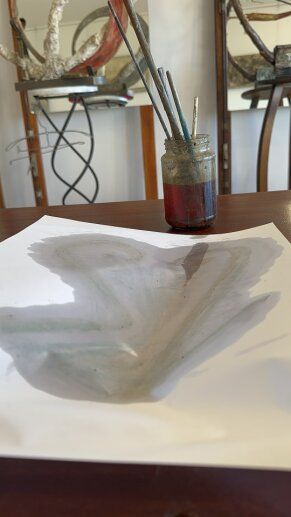
3. The Reluet method: Resilient art
Developed by Núria, the Reluet method is an art therapy method that uses abstract art and the restoration of objects to overcome loss and refocus on purposes.
Through creation, we learn to transform difficulties into strengths, recovering emotional balance and sovereignty over our own destiny.
To do this, materials are used that represent an internal connection or have some significant value.
At Reluet, wooden doors with different textures and selection of shades have been used as a complement that acts as an emotional vibration. Remember every symbolic element you select will help you rediscover yourself towards a new purpose.
These symbolic elements allow us to connect with matter, transforming everyday objects into resources for personal healing.
Well-being is not a static state, but a constant flow that we must consciously nurture. In the hustle and bustle of routine, it is common to feel that our energy is stagnating in a “swamp.”
However, the Reluet methodology reminds us of a fundamental truth: we were born rivers and are designed for movement and constant renewal.
How art therapy dissolves stress and restores your center
To recover your center, here are the best tips for applying art therapy to feel good in your daily life, designed to transform your reality through the power of resilient art:
Connect in a quiet and natural space
The first step is sensory disconnection. We recommend sitting outdoors, where contact with nature acts as an emotional regulator.
Find a quiet space where external noise dissipates, allowing your inner voice to emerge. Being in a serene environment sets the stage for creativity to flow uninterrupted by everyday chaos.
Create strokes of relief (Liberation)
Don’t seek to create a masterpiece; look for honesty. Take paper and pencil, and allow your hand to move freely. This exercise helps to release accumulated tensions.
As the Reluet philosophy teaches, art is symbolic surgery: by tracing, you are operating on your own concerns to give them a new form and outlet.
Artist recommendation Núria Companys
Nuria Companys Castro, Reluet art creator, always recommends carrying a “brave pencil” and a field diary. His advice is not to wait for the perfect moment to create, but to use drawing as a record of poetic survival.
She suggests that, when you feel blocked, you draw an everyday object and give it new meaning: just as for her a waterer is the will of a lineage, look for which object in your environment represents your ability to continue flowing.
Create your own “visual bridge”
Use colors and textures that resonate with your desired state. The use of light shades and organic shapes helps to reactivate calm and fluidity.
When finished, place your creation in a visible place; This object will become a reminder that you are capable of transforming mud into clarity.
Flows with abstract paintings
Within this search for well-being, abstract paintings emerge as the definitive tool of freedom. By breaking away from rigid figures and literal forms, the abstract invites us to immerse ourselves in an ocean of color and texture where there are no errors, only expressions of being.
Painting or contemplating abstract art allows the unconscious to project what words cannot say, turning the canvas into a mirror of our own resilience.
In every stain and every blurred line, there is a new thought that is integrated, reminding us that beauty lies in the free flow of creation.